


CNIO-CaixaResearch Frontiers Meeting: ‘Genome Organisation and Stability’
Publicado el 04/05/2023
**ENGLISH BELOW**

Los días 22 y 23 de mayo se celebrará el congreso CNIO-CaixaResearch Frontiers Meeting, que lleva por título «Genome Organisation and Stability». El congreso girará en torno a los últimos descubrimientos sobre la estructura tridimensional del genoma y su repercusión en la estabilidad genómica. Según estudios recientes, los errores en la estructura del genoma están relacionados con el cáncer.
Las células han desarrollado la capacidad de plegar y organizar su ADN a la perfección. Cada célula de nuestro cuerpo contiene más de dos metros de ADN. Si estas moléculas simplemente se comprimieran formando una bola, la maraña resultante sería más grande que la célula. Sin embargo, nuestras células saben empaquetar hábilmente este material genético en el núcleo celular.
El estudio del plegamiento del ADN ha suscitado un gran interés en años recientes. Según los últimos hallazgos, la forma tridimensional del ADN determina cómo se expresan los genes, debido a que entran en contacto zonas distantes de la molécula.
El congreso reunirá a veinte expertos internacionales en este campo de investigación para debatir acerca de los últimos descubrimientos sobre la estructura tridimensional del genoma y su repercusión en la estabilidad genómica. Además, comprender el plegamiento del ADN contribuirá a identificar las zonas más frágiles e inestables del genoma, propensas a sufrir reordenamientos del material genético que aumentan la inestabilidad del genoma y conducen a la aparición de fallos en la célula. Recientemente se ha descubierto que estos procesos están directamente relacionados con el cáncer.
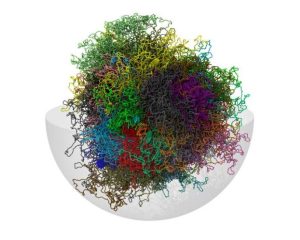
Simulación de la estructura de los cromosomas en 3D. / Fotografía: M. Di Stefano y C. Micheletti, SISSA.
«El plegamiento tridimensional [del ADN] en el núcleo celular determina cómo las células leen, interpretan y mantienen la información del genoma. Su estudio ha suscitado un gran interés en los últimos años», señalan los organizadores del congreso, los investigadores del CNIO Felipe Cortés, Ana Losada y Óscar Fernández-Capetillo, y Andre Nussenzweig, del Instituto Nacional del Cáncer de Estados Unidos.
«El ejemplo más ilustrativo es quizá la regulación de la expresión de los genes, que ahora es inconcebible entender sin tener en cuenta cómo está organizado estructuralmente el genoma», afirman. «Las conexiones entre la organización tridimensional del genoma y los procesos de señalización y reparación de los daños en el ADN, aunque se han descubierto hace poco, están demostrando ser fundamentales para comprender las fuentes endógenas de las roturas de ADN y los reordenamientos cromosómicos que dan lugar a la aparición y progresión del cáncer. El congreso reunirá a destacados investigadores de todo el mundo, expertos en ambos campos —la organización del genoma en 3D y la respuesta a los daños en el ADN— con el fin de crear un marco ideal para tender puentes entre estos dos aspectos fundamentales de la dinámica del genoma.»
En su conjunto, el congreso pretende superar la brecha existente entre la organización tridimensional del genoma y la respuesta a los daños en el ADN, proporcionando un marco ideal para que destacados investigadores de todo el mundo, expertos en ambos campos, se reúnan y compartan sus conocimientos.
Este artículo es una adaptación de un artículo publicado originalmente en el sitio web del CNIO.
*****
CNIO-CaixaResearch Frontiers Meeting: ‘Genome Organisation and Stability’
The CNIO-CaixaResearch Frontiers Meeting ‘Genome Organisation and Stability’ is set to take place on 22 and 23 May. The conference will focus on the latest research findings related to the 3D structure of the genome and how it impacts genome stability. Recent discoveries have linked errors in the genome’s structure to cancer.
Cells have evolved the ability to fold and organise their DNA to perfection. Each cell in our body contains over 2 metres of DNA. If these molecules were simply compressed into a ball, the resulting tangle would be larger than the cell itself. However, our cells manage to neatly package this genetic material into their cell nucleus.
The study of DNA folding has gained significant attention in recent years, with the latest findings indicating that the three-dimensional shape of DNA determines how genes are expressed, as distant areas of the molecule come into contact.
The conference will bring together twenty international experts in the field to discuss the latest findings related to the 3D structure of the genome and its impact on genome stability. Understanding DNA folding will also help identify the most fragile and unstable areas of the genome, which are susceptible to rearrangements of the genetic material, leading to genome instability and failures in the cell. These processes have recently been discovered to have a direct link to cancer.
Simulation of the structure of chromosomes in 3-D. / Credit: M. Di Stefano and C. Micheletti, SISSA.
“The three-dimensional folding [of DNA] in the cell nucleus determines how cells read, interpret and maintain the information in the genome. Its study has attracted extraordinary attention in the last few years,” say the conference organisers, CNIO researchers Felipe Cortés, Ana Losada and Óscar Fernández-Capetillo, as well as Andre Nussenzweig, from the U.S. National Cancer Institute.
“The most illustrative example for this is perhaps the regulation of gene expression, which is now unconceivable to understand without taking into account how the genome is structurally organised”, they say. “The connections between 3D genome organisation and the processes that signal and repair DNA damage are, however, only now starting to emerge, and proving fundamental to understanding the endogenous sources of DNA breaks and chromosomal rearrangement events that drive cancer onset and progression. In this meeting we aim to bring together world-leading researchers in both fields, 3D genome organisation and the DNA-damage response, in order to provide an ideal setting to bridge the gap between these two fundamental aspects of genome dynamics”.
Overall, the conference aims to bridge the gap between 3D genome organisation and the DNA damage response, providing an ideal setting for world-leading researchers in both fields to come together and share their insights.
The article was adapted from an article originally published on the CNIO website.