

2025 through a microscope
Published on 12/12/2025
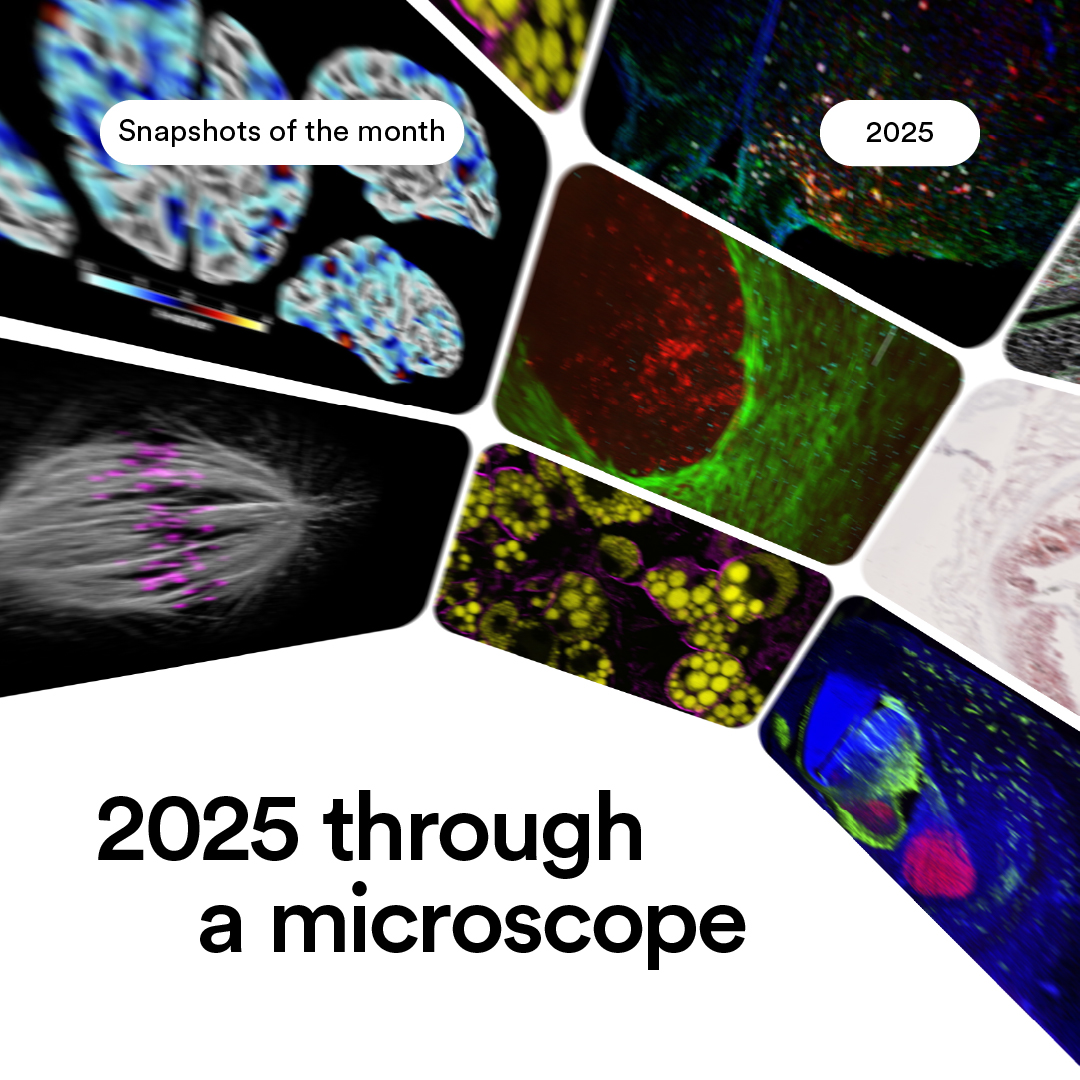
One of the most powerful driving forces in human beings is curiosity: the impulse that leads us to explore the unknown, to comprehend the world around us and even understand our own biology. Curiosity can arise from a simple desire to know something but also from a desire to transform knowledge into health or social impact.
The Snapshots of 2025 are an example of how, through research, curiosity can become advances in health. Here are eight images taken by researchers from our network that reflect some of the most notable discoveries of the year but which, thanks to their colours and textures, could also pass for authentic works of art. In several of them, artists awarded fellowships by ”la Caixa” Foundation have contributed their creative interpretation, inviting us to contemplate science from a completely new perspective.
New possibilities to tackle cancer
The microtubules seen in the image, made up of proteins called tubulins, act as a kind of scaffolding that supports the cell and coordinates its movements. They’re involved, for instance, in the distribution of DNA during cell division, a process which, if altered, can lead to cancer.
A study led by Helder Maiato, at i3S in Oporto, has discovered that a chemical modification in the alpha-tubulin, namely detyrosination, ensures the chromosomes are correctly regulated during cell division, a finding that could help to improve the diagnosis and treatment of cancer.
Read the full summary and this X thread with more details!
Our allies against excess calories
When we consume more calories than we need, cells called adipocytes store the excess as fat to prevent it from being deposited in other organs and tissues, where it could be harmful.
A CNIC study, led by Miguel Ángel del Pozo, has revealed how these cells manage to expand without becoming overwhelmed, specifically thanks to caveolae, small folds in the cell membrane that act as sensors and transducers of tension, enabling cells to store large amounts of lipids safely. This finding has improved our understanding of metabolic diseases and opens the door to new strategies to combat disorders related to excess energy, such as obesity and metabolic syndrome.
Find out more in the full summary and X thread!
A key factor as from the early stages of Alzheimer’s
Alzheimer’s causes a progressive deterioration in the neurones, affecting the patient’s memory, their capacity for personal relations and even their identity, and there’s still no cure. Traditionally it was thought that, for this brain damage to occur, there had to be two proteins present associated with the disease: amyloid beta and tau.
However, a recent study by the Barcelonaβeta Brain Research Center (BBRC) has discovered that, by itself, amyloid beta can damage the hippocampus (a key region for the memory) in the early stages of Alzheimer’s and can therefore be an early indicator. This finding, based on samples from the Alfa + cohort, promoted by “la Caixa” Foundation and using high-resolution MRI, underlines the importance of early detection and the need for clinical trials aimed at people at risk of developing Alzheimer’s.
Want to know more? Read the full summary and the X thread.
A major breakthrough to combat liver cancer
More than 860,000 cases of liver cancer are diagnosed each year, with hepatocellular carcinoma being the most common form and one of the most fatal. The disease is complex as there are four subtypes with different genetic alterations and characteristics, making it difficult to predict how each patient will respond to treatment.
A study led by Dr. Josep M. Llovet from Hospital Clínic – IDIBAPS has developed a screening platform with 25 mouse models and organoids (miniature organs) that reproduce these subtypes and help to assess the efficacy of treatments in each case. Preliminary results point to cladribine as a promising treatment in combination with standard-of-care treatment, paving the way towards more precise and personalised therapies.
Find out more in the full summary and the X thread!
The cellular journey that shapes our face
In this Snapshot we can see neural crest cells during embryonic development, migrating to form structures, such as the face. Eloísa Herrera‘s group, from the Institute for Neurosciences CSIC-UMH, has discovered that two proteins, ARID1A and ZIC2, are crucial to these cells starting their journey and, when they fail, this can lead to craniofacial malformations. This discovery has therefore opened to the door to future therapies.
For the ”la Caixa” fellow and artist Marta Velasco, the same image suggests the passage of time, from the miniscule to enormous, millennia-old surfaces, reminding her of the work by artists such as Helen Frankenthaler and Tracey Emin. As we can see, a scientific image can be both a clue to understanding the development of our bodies and also a source of visual inspiration.
For more details, see the full interview and this X thread.
A new clue to combat heart attacks
For the ”la Caixa” Foundation fellow Guillermo Mora, a laboratory and an artist’s studio have a lot in common: in both there’s searching, trial and error. When he looks at this Snapshot he sees displacement, a map of movement and separation that reminds him of Karla Black‘s work. But what are we actually seeing?
The image shows an artery with the fatty plaques accumulating on its walls that can cause atherosclerosis. David Sancho‘s team at CNIC has discovered that certain immune system cells, namely cDC1, are involved in the formation of these plaques. When they’re eliminated in animal models, the plaques are reduced, making it possible to develop more precise and effective therapies.
Find out more in the full interview and this X thread.
An unusual connection between brain and gut
At first sight, this image might look like a contemporary work of art with an artificial, almost random texture. For Gema Álava, artist and ”la Caixa” Foundation fellow, it evokes a star-filled sky or a cluster of cities seen from the air, and she’d entitled it “Universes of the maximum and of the minimum”. Because of its dynamism and the sensation of suspended movement, it reminds her of Jackson Pollock‘s work.
In actual fact, the Snapshot shows POMC neurons in the hypothalamus, an area of the brain that regulates hunger and the metabolism. The team of Marc Claret, an IDIBAPS researcher, has discovered that these neurons can alter the composition of intestinal microbiota in just a few hours, confirming that the brain and gut communicate in both directions. This finding could lead to new ways to treat diseases such as obesity, type 2 diabetes and certain digestive disorders.
Read more in the full interview and the thread on X and Bluesky.
The cellular shield that protects cancer
Both in art and in cancer research, looking beyond the evident can transform how we see a work of art or understand a disease. For Max Azemar, artist and ”la Caixa” Foundation fellow, the textures and overlayering of different planes in this image are reminiscent of the instant of an explosion of light, the energy from the northern lights, and even the representation of absinthe in 19th-century impressionist paintings.
At a scientific level, the image shows a discovery made by the team of Xavier Trepat and Alice Perucca from IBEC: fibroblasts, cells in the tumour’s environment, form a barrier that prevents the body’s immune cells from eliminating breast cancer cells. They discovered this thanks to MIRO, a “chip” developed by the group that recreates a tumour and its environment, allowing them to observe how such barriers hinder immunotherapy and allowing them to explore new strategies towards more effective and personalised treatments.
For more details, see the full interview and the thread on X and Bluesky.