

“Universes of the maximum and minimum”
Published on 16/10/2025
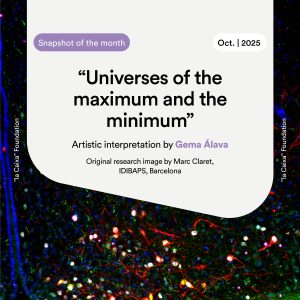
Sometimes, all we need to do is change our angle of perspective to realise that what had previously appeared to be splashes of colour, spontaneous shapes and lines that lead nowhere are, in fact, a message.
And that’s the case of this latest CaixaResearch Snapshot. It could be a contemporary work of art with an artificial, abstract, almost random texture. But what you can see here goes beyond art. It’s a scientific image that contains an important discovery, namely confirmation that our brain and gut communicate directly and in both directions.
To analyse this image from two different but complementary perspectives, we asked Marc Claret, principal investigator for a study published in Nature Metabolism (Institut d’Investigacions Biomèdiques August Pi i Sunyer, Barcelona) and member of the CaixaResearch network, and Gema Álava, ”la Caixa” Foundation fellow and a specialist in visual art.
Together, we’ll take a look at the details that turn the lines, dots and chiaroscuro of this image into a work of art and, at the same time, a great scientific breakthrough. Let’s start with Gema.
What title would you give this image, and why?
G: How we interpret an image depends on where and how we’re looking at it. For example, this image shows something my retina would never be able to see without the help of a microscope.
But what if I saw it from an airplane window? The white dots would remind me of cities lit up in the middle of the night; clusters of buildings and roads against a dark background, which could be a desert or ocean. On the other hand, if I looked at it through a telescope, it would be reminiscent of a starry sky, infinite and abstract.
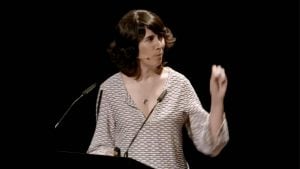
Gema Álava
This dual interpretation isn’t by chance: there’s a visual symmetry between the microscopic and the astronomical. As if the structures that make up the smallest thing and the largest are based on the same geometric language. Because of this duality, because of its ability to evoke both the infinitesimal and the immense, I’d call this image “Universes of the maximum and minimum”.
If it had been created by an artist, who would be the likely candidate?
G: It reminds me of the abstract paintings by the American artist Jackson Pollock. His works are full of dots and lines of paint that are suspended, almost floating, created by his characteristic dripping technique: letting the paint fall directly from the brush or pot, without the artist touching the canvas. This produces dynamic shapes, as if they were moving lights.
What’s more, the figures he creates have a particular feature: they function as fractals, which means that the image doesn’t change much in terms of its structure as you get closer to it. It’s that internal coherence, that complexity within each level of scale that connects me to the scientific image we have here.
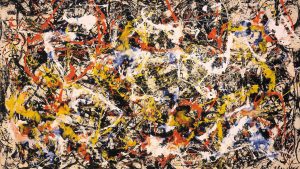
© Pollock-Krasner Foundation / Artists Rights Society (ARS), Nova York
But what are we actually looking at here, Marc?
M: Illuminated in white, we can see a kind of neuron called POMC (proopiomelanocortin neuros), which stand out among the various cellular structures of different colours. These cells are found in an area of the brain called the hypothalamus and they play a fundamental role in regulating hunger and the body’s metabolism.
And what’s the discovery behind this image?
M: We’ve found that certain neurons in the hypothalamus, such as POMCs, are able to modify the composition of the intestinal bacteria that make up the microbiota very quickly (in just 2-4 hours).
We already knew that the microbiota influences the brain; what’s known as the “gut-brain axis”. But this study shows that there’s also a reverse “brain-gut” pathway, via which the brain can alter communities of intestinal bacteria almost in real time.
Although we’ve yet to fully understand the physiological purpose of this mechanism, it may allow the body to adapt how it manages nutrients and energy after each meal.
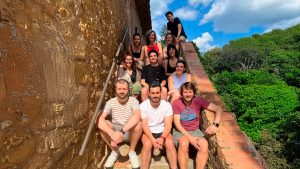
Marc Claret’s research group, IDIBAPS.
That sounds like a discovery with great potential. What impact could it have on the field of health?
M: In addition to expanding our knowledge of the brain-gut axis, the idea that the brain can influence the microbiota in real time paves the way for a completely new therapeutic field. If we can find a specific, controlled way to modulate this pathway, we could develop innovative treatments for diseases such as obesity, type 2 diabetes and certain digestive disorders.
We can’t end this interview without getting an answer to a very important question. Gema, in your opinion, what’s the connection between art and science?
G: We created the terms “art” and “science” to differentiate them but both worlds spring from the same thing: experimentation, creativity, observation, imagination, curiosity. There’s a quote by a Divisionist painter that sums it up very well: “I don’t feel like an artist; I feel like a scientist experimenting with dots of colour”.
For instance, the artist Georges Seurat said, “Some say they see poetry in my paintings; I see only science”. In a way, the Pointillists invented pixels. That connection between method and expression, between structure and emotion lies at the heart of both art and scientific research.
When science approaches art, and art approaches science, we get more than a pretty picture or experimental result: a new way of looking at the world emerges. This Snapshot not only invites us to discover an innovative breakthrough regarding the brain-gut axis but also reminds us that, from the maximum to the minimum, from art to science, everything is connected.