

CaixaResearch Snapshot: a tubulin study opens up new possibilities to tackle cancer
Published on 24/01/2025
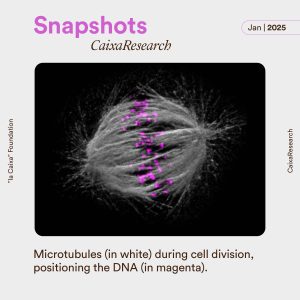
The body’s cells divide around 10 quadrillion times in a lifetime. This carefully regulated process enables an original cell to replicate itself, giving rise to two daughter cells, each with a precise copy of the cell’s DNA.
Microtubules play a critical role in allocating the chromosomes to the two daughter cells. Microtubules make up the cytoskeleton, the “scaffolding” that grows and shrinks to support the cell’s architecture and coordinate its movements, and tubulins are the proteins responsible for forming these microtubules and for how they act.
More than 40 years ago, researchers described what is today known as the “tubulin code”: the diversity of structural variants and chemical modifications undergone by these proteins, which dictate how and when the microtubules must act. Although many of these processes are already known, researchers are still attempting to understand exactly how they affect cell division.
A new study led by Helder Maiato, a researcher at the Institute for Research and Innovation in Health (i3S) in Oporto, has identified the crucial role played by a chemical modification in the alpha-tubulin, namely detyrosination, which ensures the microtubules correctly regulate the movement of the chromosomes, as well as the timely onset of their allocation during cell division. If this fails, cell division could go out of control, with the potential for cancer to develop.
This finding has not only improved our understanding of the tubulin code but also opens up fresh possibilities in the search for new strategies to improve the diagnosis and treatment of cancer. Find out more in this thread with the new CaixaResearch Snapshot: Link to thread