

How can we win the race against antibiotic resistance? We ask an expert
Published on 18/11/2025
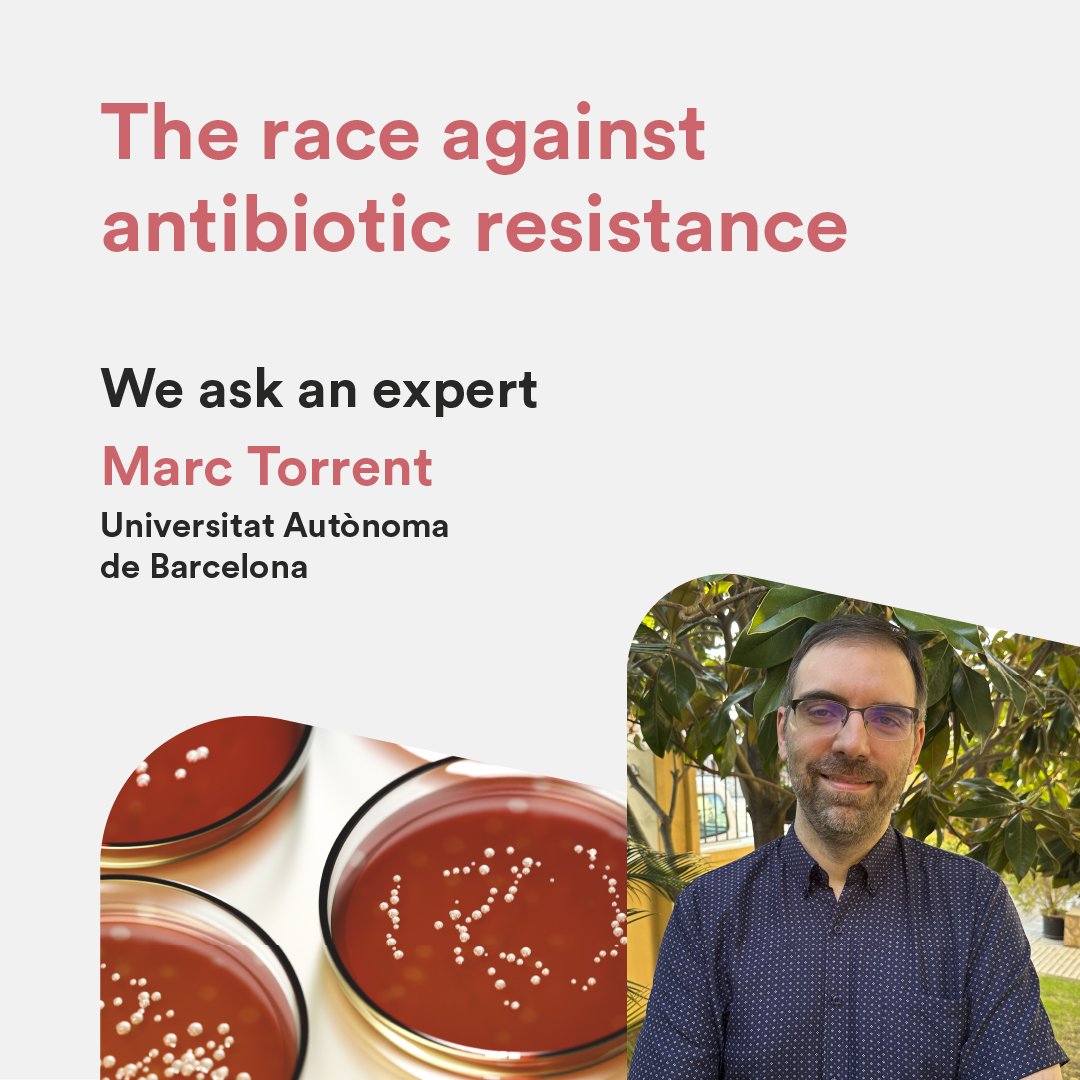
For years we’ve been reading about the ability of certain bacteria to resist traditional antibiotics. “Nightmare bacteria”, superbugs, multi-resistance are all concepts that are becoming increasingly common and reflect the same reality: the impossibility of treating bacterial infections with antimicrobial molecules.
In fact, bacteria become resistant due to random mutations. If we stop an antibiotic treatment too early, they have a greater chance to mutate; and if we use antibiotics unnecessarily, we encourage resistant strains to survive and multiply. This creates a vicious circle that jeopardises the effectiveness of our treatments.
Today we’re talking to researcher Marc Torrent, Senior Lecturer in the Department of Biochemistry and Molecular Biology at the Autonomous University of Barcelona, about this global health challenge which the WHO has dubbed the “silent pandemic”.
Why has it been given this name, Marc?
It’s called a “silent pandemic” because, unlike COVID-19, it spreads without the visibility of an acute crisis. However, the deaths linked to antibiotic-resistant bacteria continue to rise every year. It’s estimated that, in 2019, around five million people died from this cause.
What factors are driving this pandemic?
There are many but among the most important are the overprescription of antibiotics, their widespread use in livestock farming, the release of industrial waste from antibiotic production into the environment, and the global mobility of people, which helps resistant strains to spread.
We often talk in general terms about ‘antimicrobial resistance’ but do all bacteria develop resistance at the same rate?
No. The speed at which resistance develops depends on the type of antibiotic in question, the microorganism involved, and the selective pressure of the environment, such as unnecessary and constant exposure to these drugs. When only resistant strains manage to survive and multiply, some bacteria develop resistance in just a few years. What’s more, once they’re resistant they can easily transfer this to other bacterial species by exchanging DNA fragments with the mutations that make them resistant.
Recent news reports warn that ‘nightmare bacteria’ are the most worrying. Marc, what are they and what makes them so dangerous?
Nightmare bacteria are resistant to almost all antibiotics that are available, including the last-resort therapies which are reserved for the most serious infections. These strains are found mainly in hospitals and intensive care units, where the intensive use of antibiotics and invasive devices such as cannulas, ventilators and catheters make it easier for them to spread.
These infections are particularly serious In immunocompromised patients and their mortality rate can exceed 50% due to the lack of effective treatments. They’re a good example of the danger posed by multi-resistant strains if we fail to control their spread.
What challenges are currently faced by research into antimicrobial resistance?
We face three major challenges. On the one hand, the spread of resistance reduces the effectiveness of available antibiotics, whilst the scarcity of new drugs with different mechanisms further complicates the situation. This combination is particularly dangerous: if resistance advances faster than new treatments are developed, health systems could be overwhelmed.
Added to these two challenges is the lack of economic and regulatory incentives for industry to invest in antibiotics. Their limited use makes them much less profitable than drugs for chronic diseases, such as diabetes or neurodegenerative disorders, leading companies to focus their resources on more profitable areas. It’s therefore necessary to establish regulatory and financial frameworks that make research in this field profitable.
The challenges in the field of antibiotics are clear but are there any recent advances that suggest research might be on the right track?
Of course! It’s not all bad news. In recent years molecules such as teixobactin and lariocidin have been identified which, although still in the early stages of development, could lead to new effective antibiotics. In addition, the application of artificial intelligence to drug discovery is accelerating the identification of new molecules. Nor should we forget public policy initiatives that monitor the emergence of resistance and promote a more responsible use of antibiotics. All this demonstrates the importance of investing in research and establishing regulatory frameworks that make it easier to develop new treatments.
Speaking of public policy, the European Union (EU) recently launched the One Health AntiMicrobial Resistance initiative to combat antibiotic resistance. Marc, how important is this approach and what could its impact be?
The One Health approach is crucial because it covers human health, animal health and the environment, which are closely interconnected. A large number of antibiotics used in medicine have equivalents in veterinary medicine and resistance genes can circulate between animal and human bacteria through water, soil and food. Limiting the study to human health alone would be a serious mistake.
The aim of this EU initiative is to integrate public policies and surveillance systems at all three levels, promoting the rational use of antibiotics, encouraging sustainable practices that reduce their consumption and strengthening the monitoring of resistance. If implemented correctly, it could preserve the long-term effectiveness of antibiotics.
What are you currently researching?
With the support of CaixaImpulse Innovation we’re developing a new class of antibiotics that has two major advantages: on the one hand, it’s effective against resistant strains as it acts on a completely new bacterial mechanism. On the other hand, it affects targets found almost exclusively in pathogenic bacteria, preserving the beneficial bacteria in the patient’s microbiota and reducing side effects. Taken together, this approach could provide a last-resort antibiotic capable of treating currently untreatable infections and saving lives.
Finally, Marc, what can we do at home to help prevent antibiotic resistance?
Although the main responsibility lies with public health institutions and the implementation of appropriate policies, we can all contribute towards the responsible use of antibiotics at an individual level. It’s essential to take them only when prescribed by a medical professional and never to self-medicate. It’s important to remember that antibiotics only work against bacteria, not viruses, so they’re not effective against colds or flu. In addition, it’s crucial to always complete the prescribed course of treatment, as interrupting it can allow partially resistant bacteria to survive, which can then pass on their resistance genes to other bacteria.
***
As we can see, winning the race against antimicrobial resistance is possible but it requires a comprehensive approach: innovative research, effective public policies and the responsible use of antibiotics. Only then can we stop the cycle of propagation and protect the effectiveness of our treatments against this “silent pandemic”.