

Snapshot of the month: “Topography of the Living”
Published on 17/02/2026
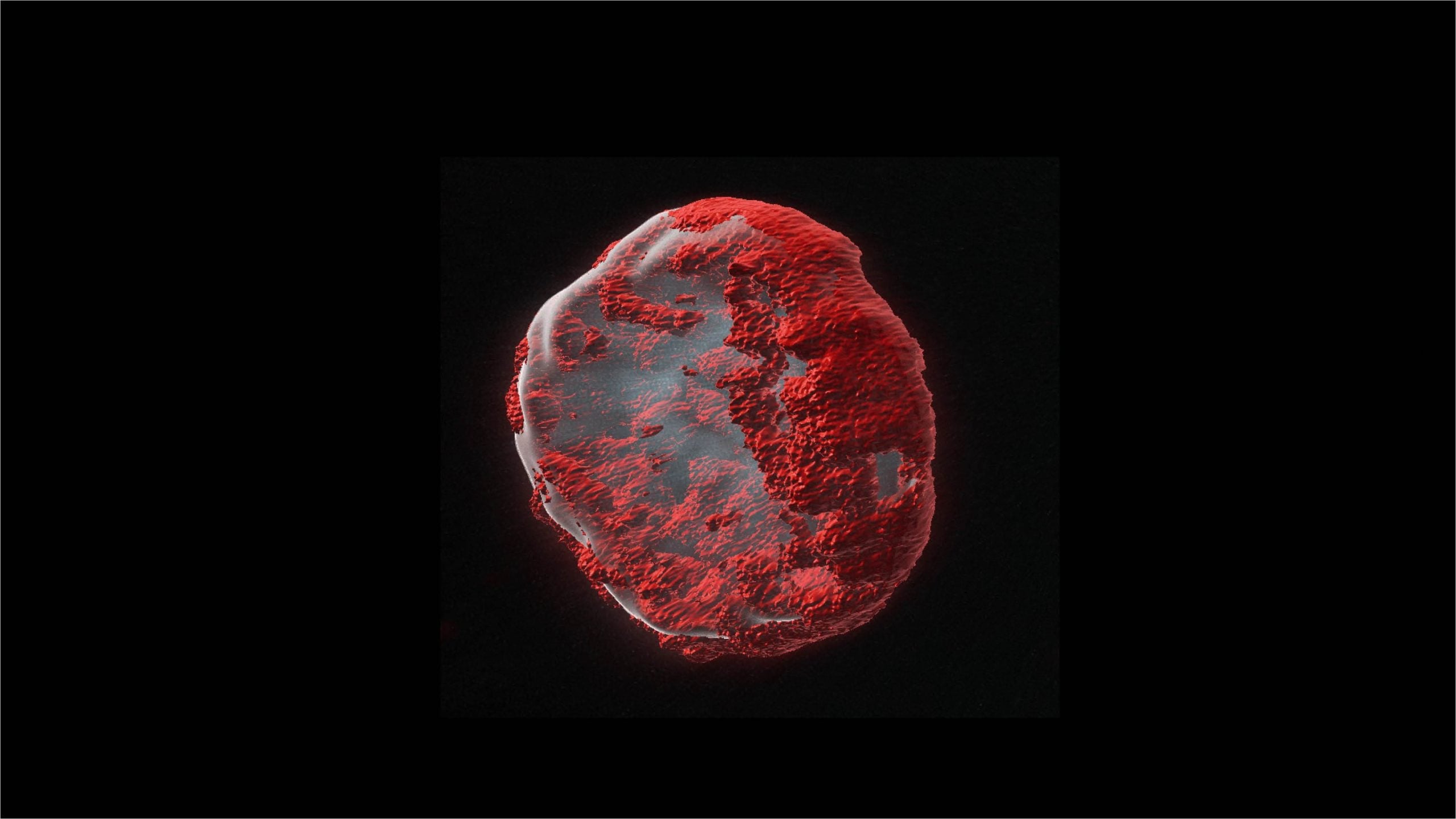
If we could perceive it, what sound would ageing make? What notes would represent the changes in shape, structure and colour that occur over the years? And, conversely, what signals would our body emit if it were capable of reversing that process?
Perhaps such a sound exists but we’re simply not capable of hearing it. Something similar occurs in our latest Snapshot of the Month. As if we were experiencing sensory synaesthesia, the scientific image in question awakens seemingly unconnected or even contradictory sensations: a changing stillness or a deafening silence. And the discovery behind it is no less disconcerting: it reveals a key mechanism involved in the ageing, and regeneration, of haematopoietic stem cells.
To analyse this image from two complementary perspectives, the artistic and the scientific, we’re joined by Sira Pellicer, a ”la Caixa” Foundation fellow, saxophonist and cultural manager; Pablo Iáñez, a fellow and researcher in the study; and Carolina Florian, a Health Research researcher at ICREA and leader of the work published in Nature Aging (Bellvitge Institute for Biomedical Research).
Let’s begin with Sira.
Sira, what title would you give this image?
Sira (S): I see a silent material, loaded with information. Something that appears still but is actually full of internal tension. The image conveys both fragility and, at the same time, a great capacity for transformation. It seems like a changing, permeable form made up of different layers.

Sira Pellicer
This makes me wonder whether qualities such as fragility, change and structure are really opposites or whether, on the contrary, they can exist side by side. It’s this coexistence I’ve tried to condense into the title: Topography of the Living.
Does it remind you of any sound or piece of music in particular?
S: Yes, of an unmistakably contemporary musical language. Specifically, I’m thinking of mute materie (2010), a piece for solo alto sax and electronics by Swiss composer Nadir Vassena. The title suggests a tension between sound and silence: mute matter becomes audible; echoes, layers and gestures emerge.
This piece has always reminded me of matter that’s seemingly silent, structured and complex but at the same time noisy to the ears of the spectator. Something very similar to what happens with this image.
Carolina, what are we actually seeing in this image?
Carolina (C): It’s an aged haematopoietic stem cell, a type of cell located in the bone marrow whose function is to produce blood cells throughout the lifetime.

Carolina Florian
The active RhoA protein is shown in red and the cell nucleus in grey. In aged stem cells, RhoA is overactivated, causing mechanical alterations in the nucleus, modifying its shape and function.
Pablo, Carolina, why is this mechanical alteration so important?
C: Because the nucleus isn’t just a container for DNA. It’s a central node for mechanical signals that regulate how the cell functions. When this is disrupted, the cell loses its ability to function properly. In our study, we’ve demonstrated that, by reducing RhoA activity with an inhibitor called Rhosin, we can reverse these mechanical alterations and rejuvenate the function of haematopoietic stem cells.
Pablo (P): This finding is particularly relevant, not only because it provides further evidence of the role played by the cell’s nucleus as a signalling centre for the mechanical forces that regulate stem cell ageing, but also because it identifies a specific way to modulate this process, improving the function of aged cells.

Pablo Iáñez
What are the implications of this discovery?
C: Haematopoietic stem cells are responsible for generating all blood cells. Their ageing is linked to cardiovascular diseases, infections, leukaemia and a reduced immune system response.
By rejuvenating these cells, we can get the entire haematopoietic system to function again like it does in a young organism, paving the way to improving the health of older people and potentially increasing life expectancy, as already noted in previous studies by the laboratory.
We can’t end this interview without answering a key question. Sira, do you think that science and art are closer than we imagine?
S: Yes. Although they’re often presented as opposites, both stem from curiosity and an exploration of the unknown. Both scientists and artists observe, ask questions and experiment. Their language and objectives may differ but both share the same basis: the need to understand, represent and make sense of the world around us.
A new map of the living
This study not only expands our knowledge of stem cell ageing but also shows that how they function depends on an internal architecture that’s constantly adjusting. A microscopic topography made up of layers, tensions and balances.
From this perspective, Topography of the Living serves as an accurate metaphor: a way of naming how form, structure, and cellular mechanics condition life and its capacity to regenerate itself.