

News from the Lab: Ultrasound and AI to diagnose childhood meningitis
Published on 16/12/2025
Meningitis is a serious infectious disease that inflames the membranes protecting the brain and spinal cord, called meninges. Detecting the disease in its early stages is essential to prevent its most severe forms, which can even lead to death. However, the current diagnostic method, a lumbar puncture, is invasive and particularly complicated with infants, who often present with very non-specific symptoms. Furthermore, lumbar punctures to diagnose meningitis are costly tests that require a high level of specialisation and resources. As a result, they are performed less frequently in low- and middle-income countries.
Is there a way to improve and facilitate the diagnosis of meningitis? Sara Ajanovic, a paediatrician and researcher at ISGlobal and Vall d’Hebron Hospital, presents a promising alternative in this edition of News from the Lab.
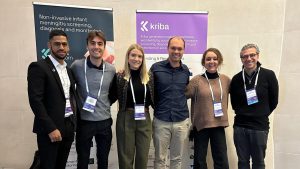
Participants in the development of Neosonics.
To address this challenge, together with the start-up Kriba, the team has developed Neosonics, a non-invasive tool that combines high-precision ultrasound with artificial intelligence to detect early signs of meningitis in newborns and infants.
The device uses the fontanelle, the natural opening in babies’ skulls that has yet to ossify, to analyse the cerebrospinal fluid in just two minutes using AI deep learning techniques, thereby identifying the presence of inflammatory cells without the need for a lumbar puncture.
To validate this innovation, the team studied more than 200 infants under 24 months of age in Spain, Morocco and Mozambique. Compared with the lumbar puncture, Neosonics correctly classified 94% of the cases, differentiating between normal cerebrospinal fluid and fluid affected by meningitis.
The results, published in Pediatric Research, show that Neosonics could become a major breakthrough for the rapid, easy, inexpensive, safe and effective diagnosis of childhood meningitis. This technology not only avoids an invasive procedure but can also make a decisive contribution to the global fight against this disease.