

A scientific approach to weight
Published on 27/01/2026

We ask the experts, Guadalupe Sabio and Beatriz Cicuéndez: How can we approach weight from a scientific view?
A new year has begun and, with it, new (or renewed) resolutions. Perhaps to take up a new hobby? Join a gym? Go on a diet to lose a few kilos? In any case, it’s common for our weight to figure prominently in a lot of these proposals, as indeed it has in many headlines recently.
Ozempic, Mounjaro, Wegovy… The emergence of new drugs that promise rapid, almost miraculous weight loss has once again placed weight at the centre of social debate, from the press to social media and everyday conversations. But what if we look beyond the number shown by the scales and take this issue to the lab?
In this Ask the Expert, we propose shifting the focus from the urgent desire to lose weight to the need to understand the reasons for being overweight in the first place and its consequences as a complex health problem. To do so, we spoke with Guadalupe Sabio, an expert researcher in metabolism, and Beatriz Cicuéndez, a doctoral student and “la Caixa” Foundation fellow. So what does science say about how to deal with weight problems? And why are there no miracle solutions?
Let’s begin:
-
Guadalupe, Beatriz, at a time when the use of bodyweight as a diagnostic tool is being questioned, are scales really a good tool for detecting obesity?
“It’s important to remember that obesity is really a disease of the adipose tissue” explains Guadalupe, “and, as such, what matters is not only how much adipose tissue we have but also its condition and how it functions: is it healthy or is it dysfunctional? Focusing solely on the number recorded by scales means we’re only looking at the most superficial part of the problem”.

Guadalupe Sabio
“Furthermore, bodyweight as data is incomplete” adds Beatriz. “We need more complex analyses to determine what proportion of the weight is muscle, bone or fat, and also what type of fat“.
-
When we talk about bodyweight, which factors are often overlooked?
“The focus tends to be on individual habits while fundamental biological aspects are ignored” Guadalupe points out. “For example, adipose tissue is an organ. And, like any other organ, it can become diseased and needs care. Its health is essential because it regulates the metabolism of other organs and, when it’s altered, it can contribute to diseases such as diabetes and fatty liver, and even increase the risk of certain types of cancer. However, these mechanisms are rarely mentioned in public discourse”.
“What’s more, there are also biological factors specific to each person” explains Beatriz. “Your genetic predisposition, modulated by environmental factors or what we call epigenetics, plays a huge part. Likewise, each person has a different basal metabolic rate and this is also affected by hormonal changes, certain medications, sleep quality, stress and even our gut microbiota, which determines how we absorb and use energy.”
-
Ozempic, Mounjaro, Wegovy… New treatments based on GLP-1 agonists are becoming increasingly common. But where do they come from and how do they work?
“These drugs are based on molecules discovered whilst studying how organs communicate with each other” explains Guadalupe. “The gut, for example, sends signals to the brain to indicate satiety. One of these is GLP-1, a protein that tells the brain to stop eating“.
In addition to reducing the appetite, GLP-1 also regulates the metabolism and insulin action in organs such as the liver. “Once this function was understood, the strategy adopted was to modify this protein so it would last longer in the blood, thereby boosting its beneficial effects” she adds.
-
Beatriz, why have these drugs roused so much interest in medical and social circles?
“Finding effective drugs with acceptable side effects for a chronic disease such as obesity, which affects key organs such as the heart and liver, has been a major challenge” explains Beatriz. “What’s innovative about these drugs is that they take advantage of a molecule that already exists in our body and acts naturally. This improves their safety profile and reduces the likelihood of serious adverse effects“.

Beatriz Cicuéndez
-
Even so, the first reports of their side effects on health are already appearing. What risks are known so far and what questions remain unanswered?
“The most common side effects are gastrointestinal, such as nausea or digestive discomfort, especially at the beginning of the treatment” notes Beatriz. “Although they’re generally considered to be safe drugs, we still need to determine some important facts, especially in relation to very long-term use. Obesity is a chronic disease and that means prolonged treatment, so we need more data to fully understand their effects over time”.
“Another important aspect is that, in addition to losing fat, these drugs can also cause muscle loss. That’s why it’s essential to combine them with physical exercise to minimise this effect. We mustn’t forget that this is a medicine: such drugs shouldn’t be taken lightly or used for merely aesthetic purposes but must always be supervised, weighing up the benefits against the possible side effects”.
-
Apart from these types of treatments, are there alternative strategies to treat obesity?
“Unlike white fat, which we all know and whose main function is to store energy, brown fat has a different role: it generates heat through a process called thermogenesis” says Beatriz. “Instead of accumulating calories, it ‘burns’ them to maintain body temperature. Our research focuses on how we can activate this brown fat to combat obesity. So far, we’ve identified a protein, called MCJ, that acts as a ‘brake’ on the mitochondria, the energy engine for cells, in brown fat. By reducing or eliminating this protein in animal models, we’ve observed that brown fat is significantly activated. This not only helps to burn more energy and protects against weight gain, even with a high-fat diet, but also prevents the excessive accumulation of fat without affecting muscle mass” she explains.
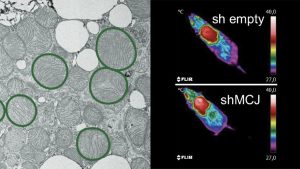
Left: electron microscopy of brown adipose tissue from a mouse lacking the MCJ protein, showing alterations in its mitochondria. Right: temperature difference in brown adipose tissue between a mouse lacking MCJ (sh MCJ) and a normal mouse (sh empty).
And the benefits don’t end there. “We’ve seen that the activation of brown fat reduces blood glucose levels, improves insulin sensitivity and promotes a healthier cholesterol profile” adds Beatriz. “All this makes it a promising strategy for treating obesity and associated diseases, such as type 2 diabetes” she notes.
Even so, the researcher emphasises that any intervention must take into account the complex role of adipose tissue in the body. “White fat isn’t just an energy reserve: it functions as an endocrine organ, releasing hormones and signals that regulate the metabolism. Something similar occurs with brown fat which, in addition to generating heat, seems to perform key endocrine functions, influencing the metabolism of distant organs”.
-
Looking to the future: how do you think the way we research, understand and treat obesity will change over the coming years?
“It’s important to remember that many of the drugs we use today are the result of discoveries made more than twenty years ago in basic research” says Guadalupe. “Without that prior knowledge, new treatments for obesity wouldn’t have been possible. Basic research helps us to understand the mechanisms that cause the disease and paves the way for more effective, safer therapies that are better adapted to each person. Without it, we only treat the consequences. It’s the cornerstone of medicine: just as you can’t build a house without good foundations, we can’t neglect the basis on which scientific advances are built”.
“Research is moving towards more personalised medicine and this is key: people of the same weight can have very different metabolic states” explains Beatriz. “The big challenge today is to identify markers that indicate when adipose tissue is healthy and when it’s diseased”.
Only then, she concludes, “will we stop treating all patients the same and be able to approach weight from a scientific perspective: not as an obsession with losing kilos but as a tool for better long-term health“.