

The female entrepreneurs transforming healthcare
Published on 19/11/2025
Melanie Perkins, co-founder of Canva; Arianna Huffington, founder of The Huffington Post; Jennifer Doudna, winner of the 2020 Nobel Prize in Chemistry for CRISPR-Cas9 gene editing technology and founder of numerous scientific start-ups; and Daphne Koller, co-founder of Coursera. These are some of the until-recently-minority cases of women leading companies capable of rewriting the rules of innovation.
Things are changing but the scenario is still strikingly unequal. Women own just one in four companies globally and, in Europe alone, they account for 73% of the “missing” entrepreneurs. This means there could be 5.5 million more women starting and managing new businesses if they had the same opportunities and participated in early-stage entrepreneurship at the same rate as men aged 30 to 49.
The figures are as revealing as they are paradoxical: women consistently outperform men in obtaining university degrees but, as the years go by and they climb higher up the corporate ladder, they hit the infamous “glass ceiling” and the percentage of women in senior positions plummets.
Science is no exception, being a field in which the hierarchy and distribution of resources have followed the same patterns for a long time. However, more and more female researchers are choosing to make the leap from the lab to the market.
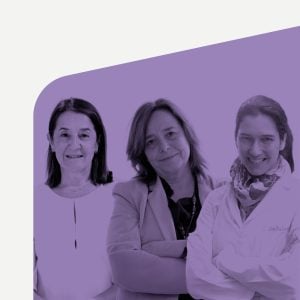
To mark Women’s Entrepreneurship Day, we spoke to Pilar Coy, Malu Martínez and Valle Palomo, three researchers from the CaixaImpulse programme who decided to become entrepreneurs in order to transfer the impact of their scientific knowledge to society.
The drive to become an entrepreneur
“After more than 30 years of research, I saw an opportunity for the results of our work to have an impact on improving patients’ lives“.
This was the spark that led Pilar Coy, a researcher at the University of Murcia, to lay the foundation stone for her project: to develop a minimally invasive device for the early detection of endometrial cancer.
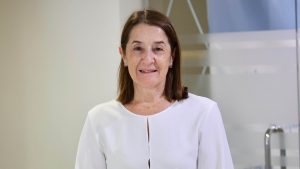
Pilar Coy
That same drive has also propelled Malu Martínez, who’s developing an RNA-based therapeutic strategy for liver diseases at the CIC bioGUNE Research Centre, as well as Valle Palomo, who’s researching a biomarker for the earlier diagnosis of ALS at the IMDEA Nanoscience Institute.
Basic research lays the foundations of knowledge from which all biomedical advances are developed. “That’s why science is a necessity, although it may sometimes be perceived as a luxury” explains Malu. “And that’s also why entrepreneurship in this field is about transforming ideas into real solutions“.
Starting from scratch
“Entrepreneurship means constantly rowing against the tide” acknowledges Valle. “It’s a complicated journey but, for me, research makes no sense if we don’t try to transfer it“.
The obstacles to achieving this are many and come from different fronts. “The scientific challenge is to build a solid foundation that justifies the investment. Without funding, you can’t get past the first step, so it’s key to learn how to seek it out, manage it and justify it” explains Malu. “On an emotional level, the journey is a real rollercoaster: the uncertainty is greater than in research because a lot of decisions are beyond your control”.
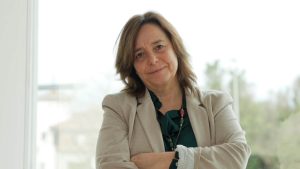
Malu Martínez
In a way, becoming an entrepreneur in science means starting from scratch. “When I was nearing the end of my science degree, I had to accept that entrepreneurship meant entering a new world which was exciting and rewarding in some ways but also requires all my energy” explains Pilar.
The fact is that becoming an entrepreneur means reinventing yourself. “You need to master skills that aren’t taught in the laboratory” notes Valle. “Intellectual and industrial property, business models, market dynamics, project feasibility…”. “It also requires learning to negotiate, to communicate outside the range of scientific language, and especially to listen” adds Malu. “Because decisions are often based not only on the data but also on people’s interests, perceptions or even intuition”.
Breaking through the glass ceiling
“There are still a lot of barriers, both structural and cultural, that make it difficult for female-led projects to secure funding and resources” warns Valle.
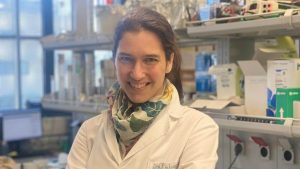
Valle Palomo
“We don’t have the same visibility or access to decision-making or investment networks. We often come up against unconscious biases that cast doubt on our leadership abilities or strategic vision, especially in sectors traditionally dominated by men” notes Malu.
Added to this is another significant challenge: the work-life balance. “Entrepreneurship requires huge dedication and a lot of women have to juggle it with family responsibilities that aren’t always shared out equally”. This is compounded by a lack of visible role models, complicating their efforts. “Seeing other women leading companies, negotiating with investors or licensing technologies is inspiring but still rare” says Malu. “We need to make these cases more visible and to create spaces where women can develop without additional obstacles”.
Pilar points out that there are also internal barriers: “Sometimes we impose limits on ourselves, either because we’re too demanding of ourselves or because of our sense of family responsibility, which take us away from the business world”.
Being supported along the way
“Forming part of the CaixaImpulse programme has made my life easier from the very start” says Pilar Coy. “To be an entrepreneur, you need to surround yourself with business experts from the outset. You can’t progress with just scientists on your team”.
“The programme has put us in touch with professionals who’ve been instrumental in the process: from licensing to discussions with investors. It has undoubtedly been a turning point in our entrepreneurial journey” adds Malu.
Valle agrees: “We have personalised mentoring and high-quality training, focused on covering the unmet needs of researchers. There’s a real commitment to the success of our projects”.
Paving the way
“Entrepreneurship as a scientist is not only possible; it’s necessary” says Malu. “If you’re considering it, my advice is to go for it, without hesitation. It’s a road full of challenges but also incredible moments. Don’t be afraid to ask questions, to learn and let yourself be guided”.
Valle believes that “it’s worth having a go so you don’t start wondering, later on, what might have been. The more of us there are, the easier it will be for those who come after us”.
As Malu points out, “being a female entrepreneur in science still requires an extra effort. That’s why, in a way, being a female scientist is also an act of resistance and transformation. And here we are, paving the way”.