Tuesday 25

CaixaResearch Snapshot: adipocytes, our allies against excess calories

Published on 25/02/2025

Thousands of years ago, finding food was no easy task and our bodies became increasingly specialised in storing a precious energy resource: fat. 

However, now the situation is quite different. In today’s society, with our typically sedentary lives and high-calorie diets, we accumulate fat very quickly and its excess in our bodies is directly related to obesity and other metabolic health problems.

When we ingest excess calories, cells called adipocytes are responsible for storing them as fat. This prevents fat from being deposited in other tissues and organs such as the liver or the walls of blood vessels, which would be harmful. Until now, it was not fully understood how adipocytes managed to store this fat without becoming overwhelmed but,

Share

0
Tuesday 11

No-one dreams of something they don’t know

Published on 11/02/2025

“Spanish girls want to be #ASTRONAUTS. It’s not a dream; it’s a reality” posted Sara García Alonso after the publication of the Annual Adecco Survey, which asked over 1,100 children about what they dreamed of doing as a job.

Sara, a molecular biologist at Spain’s National Cancer Research Centre (CNIO) and the country’s first candidate to become an astronaut for the European Space Agency, has managed to make travelling into space seem possible and has fired the imagination of young girls. Because when a woman is visible, when she forges a path, many more girls can see themselves in her place. 

That’s why today, to commemorate the International Day of Women and Girls in Science,

Share

0
Friday 24

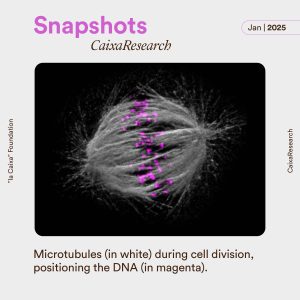
CaixaResearch Snapshot: a tubulin study opens up new possibilities to tackle cancer

Published on 24/01/2025

The body’s cells divide around 10 quadrillion times in a lifetime. This carefully regulated process enables an original cell to replicate itself, giving rise to two daughter cells, each with a precise copy of the cell’s DNA.

Microtubules play a critical role in allocating the chromosomes to the two daughter cells. Microtubules make up the cytoskeleton, the “scaffolding” that grows and shrinks to support the cell’s architecture and coordinate its movements, and tubulins are the proteins responsible for forming these microtubules and for how they act.

More than 40 years ago, researchers described what is today known as the “tubulin code”: the diversity of structural variants and chemical modifications undergone by these proteins,

Share

0
  • Archive