

Taste beyond the mouth
Published on 27/10/2026
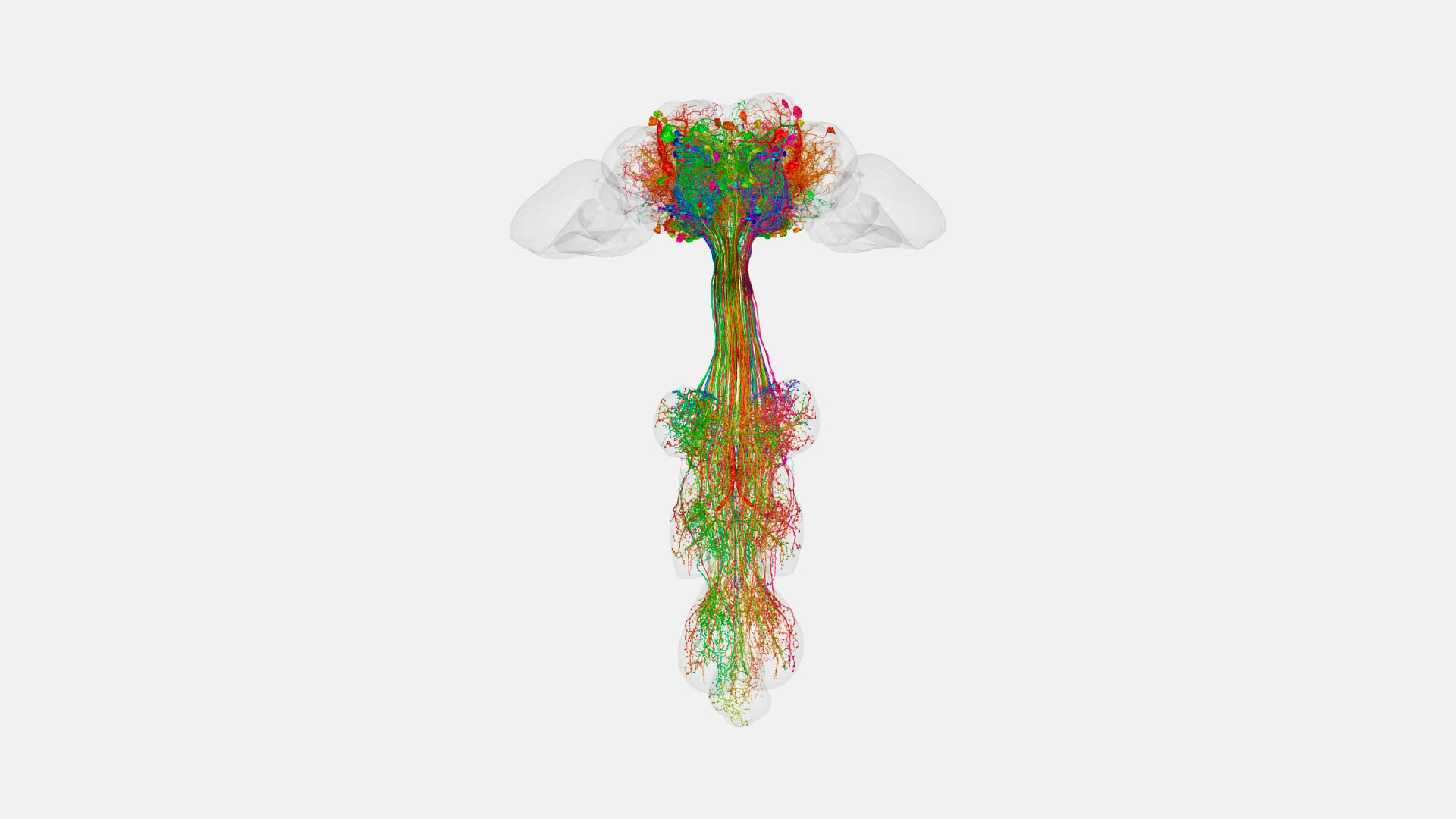
Descending ventral neurons in a male fly. Credit: Inês de Haan Vicente.
When Carlos Ribeiro, a researcher from our network, was starting his postdoctoral career, he couldn’t have even dreamt of the achievement his research group has helped bring about today: the first complete and intact connectome of the central nervous system of an adult complex animal, the fruit fly (Drosophila melanogaster). This unprecedented study has involved international collaboration between several laboratories to decipher every part of the connectome. The Behaviour and Metabolism Laboratory at the Champalimaud Centre for the Unknown, led by Ribeiro and specialising in the biology of taste and nutrition, has spearheaded the first complete map of the taste system, linking taste signals from across the body to the circuits that act on them, within this major study.
To explain this discovery, Ribeiro uses a clear metaphor: “If you wanted to understand how a computer works, you wouldn’t watch the screen. You’d want the circuit diagram to see which part talks to which. The connectome is that diagram for a nervous system.”
A four-layered map of the mind
This neuroscientific milestone encompasses 166,700 neurons and tens of millions of synapses in one continuous map of a single fly: from the sensory neurons on the body, through the brain and the nerve cord (the fly’s version of our spinal cord), all the way to the motor neurons that move the muscles. As Ribeiro emphasises, regarding the scale of this comprehensive record: “A connectome has four layers. First, the neurons themselves, the connections or synapses, the chemistry — which chemical signal a neuron probably uses to activate or silence the neurons it connects to — and, finally, the cell types, which tell us what job each one probably does.”
By mapping this information highway, the team can now follow how information flows from sensing to action. “To eat, a fly tastes food with its legs, decides in the brain, and then moves its mouth and body. For the first time, we can follow that whole path, from sensing to acting, in one map.” The map confirms in full detail what was already known: the neck is a bottleneck, since everything the brain tells the body to do must be channelled through a relatively small set of neurons running down it, in order to be transformed into action.
Carlos Ribeiro. Credit: Alexandre Azinheira, Champalimaud Foundation.
Beyond eating: the many facets of taste
Although we tend to associate taste exclusively with eating, the findings reveal that, as the researcher himself points out, “taste in a fly isn’t only about feeding. It also feeds into circuits for walking, for hormone release and for courtship”.
The study demonstrates that the same sense triggers different responses depending on the part of the body being stimulated:
- With regard to stopping whilst walking, Ribeiro explains that, when stepping on the right food, “taste neurons on the legs connect to an inhibitory neuron that supresses walking. So the moment a fly steps on good food, it stops”.
- It also influences the release of a motor brake. “You might expect a good taste to simply switch on licking. Instead, it mostly works by releasing a brake: the taste silences the neurons that normally hold licking back”, illustrates Ribeiro.
- Regarding anticipatory hormonal responses, he explains that “taste neurons in the throat reach the insulin-producing cells in just three steps”, which allows the body to prepare whilst it’s still ingesting the food. People also release insulin in anticipation of food, at its sight, smell or taste. The fly map shows a specific wiring that could do this.
- Finally, regarding social courtship, he notes that “taste neurons on the legs pick up pheromones when flies touch, and feed into circuits that promote courtship”.
The microbiome and the mysteries of perception
One of the flagship lines of research in Ribeiro’s laboratory is how gut bacteria influence food choices. Where does this microbial dialogue fit into the new map? Ribeiro admits that we’re facing the next frontier: “The microbiome, like hunger or thirst, must change how the connectome processes information. How that works is the next big question: mapping how the connectome changes with the state of the animal.”
Regarding how flavour is constructed when other senses are involved or absent, the researcher admits that “this is one of the hardest questions in the field, and we’re only starting to understand it. We got a first glimpse in courtship in an earlier study with our collaborators in Cambridge … A female fly smells a pheromone that males carry, and she tastes the male when they touch. We found a group of neurons where the two signals meet. Switching on the smell pathway alone, or the taste pathway alone, did not change her willingness to mate. Only the two together did.” But it’s now possible to pinpoint each point of convergence where taste meets smell, vision or touch.
From the fly to humans: collaborative science and global impact
Even though the human brain has 86 billion neurons compared to the fly’s 166,700, both share the same genetic and organisational principles. For Ribeiro, the practical application for humans and public health is direct: “Insect science matters in its own right… A mosquito deciding whether to bite you, a pest deciding whether a crop is worth eating, a pollinator deciding which plant to visit: these are all taste decisions … that affect our health and our food supply.”
The researcher passionately emphasises the collaborative nature of the project. The work in his laboratory was led by Ibrahim Tastekin and Inês de Haan Vicente, alongside Rory Beresford and in close collaboration with the teams at the Janelia Research Campus (HHMI) and the lab of Greg Jefferis, one of the leaders of the connectome project, at the University of Cambridge. On this point, he concludes: “It’s exciting to do this with amazing people … and to provide these datasets for the whole community … Someone studying walking, hormones, sleep or courtship can open [this map] and see how their circuit is wired. We live in the diamond age of science and it’s a privilege to work on it and contribute to it.”